
Facility Verification
Please verify the inmate's facility before purchasing.
OR
This Publication is Restricted at this Facility.

Descripción
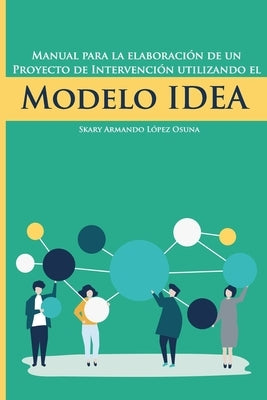
The vast majority of texts on organization deal with business problems seen from management's perspective, that is, topics such as efficiency, control, and organizational performance are the preferred subjects of scholars. However, focusing only on these arguments may not be enough. Today, a much broader planning and analysis of the organization is required, one that relies on intervention models to question reality and understand the causes and consequences of its problems in order to provide solutions and/or answers.
Likewise, it is difficult to find texts that are designed as a working manual with didactic support to guide the intervener in a simple and practical way in the identification, execution, analysis, and evaluation of intervention projects; for this reason, and throughout the four chapters of the book, tables with specific exercises are included for the intervener to carry out with the purpose of building their project. In this way, the IDEA Model is presented and developed as an intervention methodology designed to identify, correct, prevent, or develop processes, products, or services in any social, institutional, organizational, etc., context. The author holds a Doctorate in Administrative Sciences, as well as master's degrees in Marketing, Human Development, and Competency-Based Education, and is currently pursuing a Master's degree in Learning, Cognition, and Educational Development. He has almost three decades of experience working in national and international institutions and organizations as an academic-trainer, manager, researcher, and professional in administration, marketing, education, and human development; always with an interest in finding practical and concrete solutions to both superficial and profound problems. He has developed models and tools in simple formats, replicable and adaptable to different situations (such as the APT and APS management models designed to promote adult education, the Assertive Communication Ladder Model, an instrument that seeks to reduce school dropout, and the HISC tool, which is very useful for measuring the social and community impact of school centers). Communicating his most relevant experiences and findings has been one of his biggest objectives, not only thinking about the classrooms and organizations where he has worked, but with the conviction of the tireless pursuit of benefiting society.
Author: Skary Armando López Osuna
Publisher: Barker & Jules, LLC
Published: 04/11/2023
Pages: 126
Binding Type: Paperback
Weight: 0.39lbs
Size: 9.00h x 6.00w x 0.27d
ISBN13: 9798889293941
Language: Spanish
BISAC Categories:
- Business & Economics | General
Likewise, it is difficult to find texts that are designed as a working manual with didactic support to guide the intervener in a simple and practical way in the identification, execution, analysis, and evaluation of intervention projects; for this reason, and throughout the four chapters of the book, tables with specific exercises are included for the intervener to carry out with the purpose of building their project. In this way, the IDEA Model is presented and developed as an intervention methodology designed to identify, correct, prevent, or develop processes, products, or services in any social, institutional, organizational, etc., context. The author holds a Doctorate in Administrative Sciences, as well as master's degrees in Marketing, Human Development, and Competency-Based Education, and is currently pursuing a Master's degree in Learning, Cognition, and Educational Development. He has almost three decades of experience working in national and international institutions and organizations as an academic-trainer, manager, researcher, and professional in administration, marketing, education, and human development; always with an interest in finding practical and concrete solutions to both superficial and profound problems. He has developed models and tools in simple formats, replicable and adaptable to different situations (such as the APT and APS management models designed to promote adult education, the Assertive Communication Ladder Model, an instrument that seeks to reduce school dropout, and the HISC tool, which is very useful for measuring the social and community impact of school centers). Communicating his most relevant experiences and findings has been one of his biggest objectives, not only thinking about the classrooms and organizations where he has worked, but with the conviction of the tireless pursuit of benefiting society.
Author: Skary Armando López Osuna
Publisher: Barker & Jules, LLC
Published: 04/11/2023
Pages: 126
Binding Type: Paperback
Weight: 0.39lbs
Size: 9.00h x 6.00w x 0.27d
ISBN13: 9798889293941
Language: Spanish
BISAC Categories:
- Business & Economics | General
This title is not returnable