
Facility Verification
Please verify the inmate's facility before purchasing.
This Publication is Restricted at this Facility.

Descripción
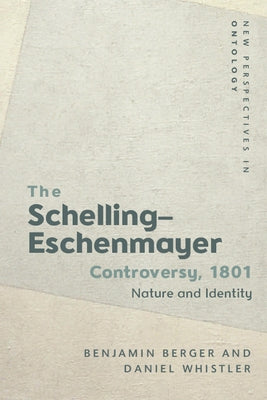
During the first decade of the 19th century, F. W. J. Schelling was involved in 3 distinct controversies with one of his most perceptive and provocative critics, A. K. A. Eschenmayer. The first of these controversies took place in 1801 and focused on the philosophy of nature. Now, Berger and Whistler provide a ground-breaking account of this moment in the history of philosophy. They argue that key Schellingian concepts, such as identity, potency and abstraction, were first forged in his early debate with Eschenmayer. Through a series of translations and commentaries, they show that the 1801 controversy is an essential resource for understanding Schelling's thought, the philosophy of nature and the origins of absolute idealism.
Author: Benjamin Berger, Daniel Whistler
Publisher: Edinburgh University Press
Published: 03/03/2022
Pages: 288
Binding Type: Paperback
Weight: 0.89lbs
Size: 9.21h x 6.14w x 0.60d
ISBN13: 9781474434409
ISBN10: 1474434401
BISAC Categories:
- Philosophy | Metaphysics
- Philosophy | History & Surveys | General
- Philosophy | Movements | Idealism
About the Author
Benjamin Berger is Visiting Assistant Professor of Philosophy at Kent State University. He is editor of a special issue of Pli, on Schelling: Powers of the Idea, 2014.
Daniel Whistler is Professor of Philosophy at Royal Holloway, University of London. He is author and editor of numerous volumes on eighteenth and nineteenth-century philosophy, including the three-volume Edinburgh Edition of the Complete Philosophical Works of François Hemsterhuis, The Schelling-Eschenmayer Controversy, 1801: Nature and Identity (EUP, 2020), The Edinburgh Critical History of Nineteenth-Century Christian Theology, The Schelling Reader (Bloomsbury, 2020) and the forthcoming Oxford Handbook of Modern French Philosophy (Oxford University Press, 2022).