
Facility Verification
Please verify the inmate's facility before purchasing.
This Publication is Restricted at this Facility.
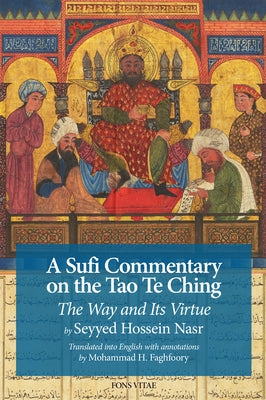

Description
Author: Seyyed Hossein Nasr
Publisher: Fons Vitae
Published: 08/01/2025
Pages: 210
Binding Type: Paperback
Weight: 0.65lbs
Size: 8.90h x 5.90w x 0.50d
ISBN13: 9798896400028
BISAC Categories:
- Religion | Islam | Sufi
- Religion | Taoism (see also PHILOSOPHY | Taoist)
About the Author
Jane Casewit holds a BA Honours degree from University of Durham (UK) and a Master's degree in education from Manchester University (UK) and Framingham University (Massachusetts). She studied in Paris and has extensive experience in translation with certificates in translation studies in French and Arabic. After teaching for many years in Morocco, Egypt and Saudi Arabia, she returned to Morocco and worked with the Ministry of Education promoting girls' education and youth employment training. She has published several articles on traditional views of femininity and currently works on translations and editing with Fons Vitae and World Wisdom. Mohammad H. Faghfoory is professor of Islamic Studies at the George Washington University and the director of the MA Program in Islamic Studies. In addition to advising graduate students' research and theses, he teaches courses on Qur'an and Hadith, Islamic Political Thought, Sufism, Islamic Philosophy and Theology, Shi' ite Islam, Islamic Art and Spirituality, Islam, and other related courses. He received his Master's degrees in history and Middle East studies from the University of Illinois, and a Master's degree and a PhD in political science and Middle East studies from the University of Wisconsin-Madison. He has taught at the University of Tehran and has been a visiting scholar at the University of California-Los Angeles, Islamic Manuscripts Specialist at Princeton University, and at the Library of Congress, and adjunct professor of Middle East History at Mary-Washington University in Fredericksburg, Virginia. Dr. Faghfoory has written, translated, and edited twelve books, numerous book chapters, articles, and book reviews (see Publications section for details). He has lectured extensively in the United States, Europe, and the Middle East, and participated in interfaith dialogue organized by American media. Toshihiko Izutsu (1914 - 1993) was a Japanese scholar who specialized in Islamic studies and comparative religion. He took an interest in linguistics at a young age, and came to know more than thirty languages, including Arabic, Hebrew, Turkish, Persian, Sanskrit, Pali, Hindustani, Russian, Greek, and Chinese. He is widely known for his translation of the Qur?an into Japanese. Seyyed Hossein Nasr, University Professor of Islamic Studies at the George Washington University, is an international authority on Islamic philosophy, mysticism, art, and science as well as comparative religion and religion and ecology. He is the author of dozens of books and hundreds of articles and the subject of a number of books, edited collections, and articles. A small sample of his recent publications include The Garden of Truth: The vision and Promise of Sufism (2007), Islam's Mystical Tradition (2007), Islam in the Modern World (2010), In Search of the Sacred (2010), and Metaphysical Penetrations (a translation of Mulla Sadra's Kitab al-Masha' ir. (2014). " The greatest honor the academic world grants to a living philosopher is the dedication of a volume of The Library of Living Philosophers to his work and thought; and the most prestigious recognition a thinker can receive in the field of natural theology is an invitation to deliver the annual Gifford Lectures at the University of Edinburgh. In the years 2000, the twenty-eighth volume of The Library of Living Philosophers was devoted to the philosophy of Seyyed Hossein Nasr, placing him in the company of Einstein, Sartre, Russell, Whitehead, and other luminaries of twentieth-century intellectual life. Fourteen years previously, Nasr had delivered the Gifford Lectures, and the text of these lectures became his magnum opus, " Knowledge and the Sacred."