
Facility Verification
Please verify the inmate's facility before purchasing.
OR
This Publication is Restricted at this Facility.

Description
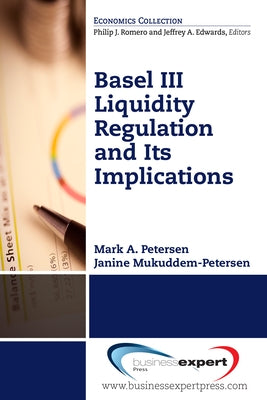
Liquidity involves the degree to which an asset can be bought or sold in the market without affecting its price. The 2007 to 2009 financial crisis was characterized by a decrease in liquidity and necessitated the introduction of Basel III capital and liquidity regulation in 2010. Inside, you'll learn how such regulations are applied on a broad crosssection of countries in order to understand and demonstrate the implications of Basel III. This book summarizes the defining features of the Basel I, II, and III Accords and their perceived shortcomings, as well as the role of the Basel Committee on Banking Supervision (BCBS) in promulgating international banking regulation. Basel III quantifies liquidity risk by using the measures liquidity coverage ratio (LCR) and net stable funding ratio (NSFR). This book discusses approximation techniques that may be used to estimate these liquidity measures. Inside, the authors highlight the connections between liquidity creation and bank capital and provide you with the details of an investigation of the risks liquidity creation generates for banks. In addition, we consider the impact of the implementation of Basel III liquidity regulation on macroeconomic variables such as GDP, investment, inflation, consumption, income, savings, and employment.
Author: Mark Petersen, Janine Mukkudem-Petersen
Publisher: Business Expert Press
Published: 05/07/2014
Pages: 190
Binding Type: Paperback
Weight: 0.58lbs
Size: 9.00h x 6.00w x 0.41d
ISBN13: 9781606498729
ISBN10: 160649872X
BISAC Categories:
- Business & Economics | Banks & Banking
Author: Mark Petersen, Janine Mukkudem-Petersen
Publisher: Business Expert Press
Published: 05/07/2014
Pages: 190
Binding Type: Paperback
Weight: 0.58lbs
Size: 9.00h x 6.00w x 0.41d
ISBN13: 9781606498729
ISBN10: 160649872X
BISAC Categories:
- Business & Economics | Banks & Banking
About the Author
Mark A. Petersen received his PhD in Applied Mathematics