
Facility Verification
Please verify the inmate's facility before purchasing.
This Publication is Restricted at this Facility.
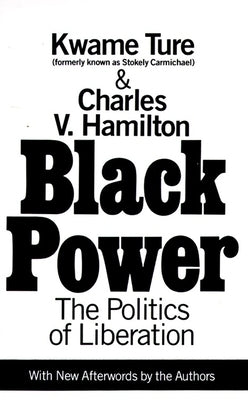

Description
A revolutionary work since its publication, Black Power exposed the depths of systemic racism in this country and provided a radical political framework for reform: true and lasting social change would only be accomplished through unity among African-Americans and their independence from the preexisting order.
Author: Charles V. Hamilton, Kwame Ture
Publisher: Vintage
Published: 11/10/1992
Pages: 256
Binding Type: Paperback
Weight: 0.60lbs
Size: 7.90h x 5.10w x 0.70d
ISBN13: 9780679743132
ISBN10: 0679743138
BISAC Categories:
- Social Science | Cultural & Ethnic Studies | American | African American & Bl
- Social Science | Discrimination
- Social Science | Minority Studies
About the Author
KWAME TURE, formerly known as Stokely Carmichael, was among the most fiery and visible leaders of Black militancy in the United States in the 1960s, first as head of the Student Nonviolent Coordinating Committee (SNCC) and then as prime minister of the Black Panther Party, where he coined the phrase "Black Power." In 1969 he cut his ties with American groups over the issue of allying with White radicals, and moved to Guinea. He declared himself a pan-Africanist. In 1978 he changed his name to Kwame Ture, to honor African socialist leaders Kwame Nkrumah and Ahmed Sekoe Toure. He lived in Guinea for 33 years, until his diagnosis with prostate cancer. He died in 1998.