

Description
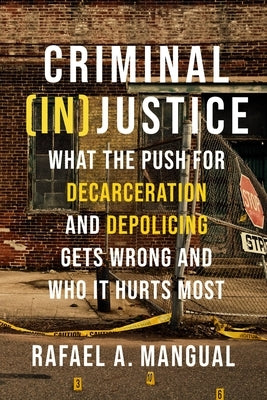
In his impassioned-yet-measured book, Rafael A. Mangual offers an incisive critique of America's increasingly radical criminal justice reform movement, and makes a convincing case against the pursuit of "justice" through mass-decarceration and depolicing.
After a summer of violent protests in 2020--sparked by the deaths of George Floyd, Breonna Taylor, and Rayshard Brooks--a dangerously false narrative gained mainstream acceptance: Criminal justice in the United States is overly punitive and racially oppressive. But, the harshest and loudest condemnations of incarceration, policing, and prosecution are often shallow and at odds with the available data. And the significant harms caused by this false narrative are borne by those who can least afford them: black and brown people who are disproportionately the victims of serious crimes.
In Criminal (In)Justice, Rafael A. Mangual offers a more balanced understanding of American criminal justice, and cautions against discarding traditional crime control measures. A powerful combination of research, data-driven policy journalism, and the author's lived experiences, this book explains what many reform advocates get wrong, and illustrates how the misguided commitment to leniency places America's most vulnerable communities at risk.
The stakes of this moment are incredibly high. Ongoing debates over criminal justice reform have the potential to transform our society for a generation--for better or for worse. Grappling with the data--and the sometimes harsh realities they reflect--is the surest way to minimize the all-too-common injustices plaguing neighborhoods that can least afford them.
Author: Rafael A. Mangual
Publisher: Center Street
Published: 07/25/2023
Pages: 256
Binding Type: Paperback
Weight: 0.50lbs
Size: 7.90h x 5.20w x 0.70d
ISBN13: 9781546001522
ISBN10: 1546001522
BISAC Categories:
- Social Science | Criminology
- Political Science | Law Enforcement
- Political Science | Commentary & Opinion
About the Author
Rafael A. Mangual is a senior fellow and head of research for policing and public safety at the Manhattan Institute for Policy Research--the think tank renowned for its scholarship on the "Broken Windows" theory of policing in the 1980s and 90s, and for its role in the transformation of New York City into one of the world's safest and most attractive urban centers. He is also a contributing editor of the Institute's flagship quarterly magazine, City Journal.