

Description
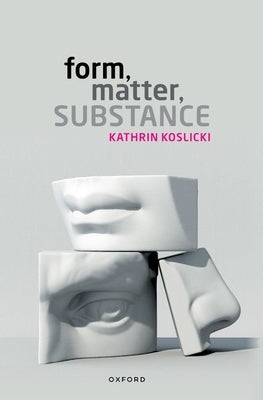
In Form, Matter, Substance, Kathrin Koslicki develops a contemporary defence of the Aristotelian doctrine of hylomorphism. According to this approach, objects are compounds of matter (hule) and form (morphe or eidos) and a living organism is not exhausted by the body, cells, organs, tissue, and the like that compose it. Koslicki argues that a hylomorphic analysis of concrete particular objects is well equipped to compete with alternative approaches when measured against a wide range of criteria of success. However, a plausible application of the doctrine of hylomorphism to the special case of concrete particular objects hinges on how hylomorphists conceive of the matter composing a concrete particular object, its form, and the hylomorphic relations which hold between a matter-form compound, its matter and its form. Koslicki offers detailed answers to the questions surrounding this approach to the metaphysics of concrete particular objects. As a result, matter-form compounds
emerge as occupying the privileged ontological status traditionally associated with substances, despite their metaphysical complexity, due to their high degree of unity.
Author: Kathrin Koslicki
Publisher: Oxford University Press, USA
Published: 06/01/2023
Pages: 288
Binding Type: Paperback
Weight: 1.00lbs
Size: 9.00h x 6.30w x 1.00d
ISBN13: 9780198880684
ISBN10: 0198880685
BISAC Categories:
- Philosophy | Metaphysics
- Philosophy | History & Surveys | Ancient & Classical
- Philosophy | Language
emerge as occupying the privileged ontological status traditionally associated with substances, despite their metaphysical complexity, due to their high degree of unity.
Author: Kathrin Koslicki
Publisher: Oxford University Press, USA
Published: 06/01/2023
Pages: 288
Binding Type: Paperback
Weight: 1.00lbs
Size: 9.00h x 6.30w x 1.00d
ISBN13: 9780198880684
ISBN10: 0198880685
BISAC Categories:
- Philosophy | Metaphysics
- Philosophy | History & Surveys | Ancient & Classical
- Philosophy | Language