
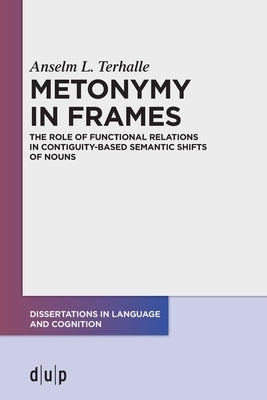

Description
This work refines the notion of metonymy and the underlying notion of conceptual contiguity by describing a fundamental structural property of metonymy.
Studied since antiquity, metonymy is a ubiquitous mechanism of meaning construction in context that involves a linguistically coded source concept that directs attention to a situationally relevant target concept. Modelling metonymic contiguity by means of recursive attribute-value structures, inspired by findings from cognitive psychology, suggests that the metonymic relation depends largely on the functionality of the source with respect to the target.
Based on this structural property, several patterns can be identified as potential bases for metonymic shifts. How these shifts are coded on the linguistic surface varies depending on whether the focus within the relevant frame is more on the source (metonymy closer to literal use) or more on the target (metonymy closer to word formation). Furthermore, decomposing the contiguity relation into functional relations hints at a potential conceptual distance between the source and target. This approach contributes to understanding the boundaries and possibilities of metonymy.
Author: Anselm L. Terhalle
Publisher: Dusseldorf University Press
Published: 12/05/2022
Pages: 241
Binding Type: Paperback
Weight: 0.83lbs
Size: 9.21h x 6.14w x 0.55d
ISBN13: 9783110755282
ISBN10: 3110755289
BISAC Categories:
- Language Arts & Disciplines | Linguistics | Semantics
- Language Arts & Disciplines | Grammar & Punctuation
About the Author
Anselm L. Terhalle, Bergische Universität Wuppertal, Germany.