
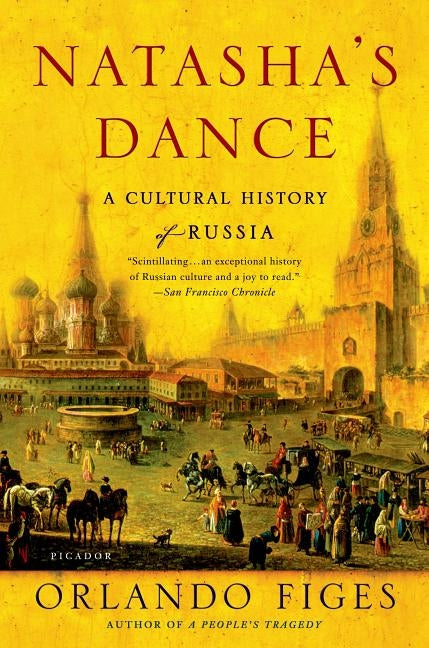

Description
History on a grand scale--an enchanting masterpiece that explores the making of one of the world's most vibrant civilizations
A People's Tragedy, wrote Eric Hobsbawm, did more to help us understand the Russian Revolution than any other book I know. Now, in Natasha's Dance, internationally renowned historian Orlando Figes does the same for Russian culture, summoning the myriad elements that formed a nation and held it together. Beginning in the eighteenth century with the building of St. Petersburg--a window on the West--and culminating with the challenges posed to Russian identity by the Soviet regime, Figes examines how writers, artists, and musicians grappled with the idea of Russia itself--its character, spiritual essence, and destiny. He skillfully interweaves the great works--by Dostoevsky, Stravinsky, and Chagall--with folk embroidery, peasant songs, religious icons, and all the customs of daily life, from food and drink to bathing habits to beliefs about the spirit world. Figes's characters range high and low: the revered Tolstoy, who left his deathbed to search for the Kingdom of God, as well as the serf girl Praskovya, who became Russian opera's first superstar and shocked society by becoming her owner's wife. Like the European-schooled countess Natasha performing an impromptu folk dance in Tolstoy's War and Peace, the spirit of Russianness is revealed by Figes as rich and uplifting, complex and contradictory--a powerful force that unified a vast country and proved more lasting than any Russian ruler or state.Author: Orlando Figes
Publisher: Picador USA
Published: 10/17/2003
Pages: 784
Binding Type: Paperback
Weight: 1.70lbs
Size: 9.20h x 6.10w x 1.50d
ISBN13: 9780312421953
ISBN10: 0312421958
BISAC Categories:
- History | Russia & the Former Soviet Union
- History | World | General
About the Author
Orlando Figes is the author of A People's Tragedy, and recipient of the Wolfson Prize for History and the Los Angeles Times Book Prize, among others. A regular contributor to The New York Times, The Washington Post, and The Times Literary Supplement, he is a professor of history at the University of London. He lives in Cambridge, England.
CUSTOMER REVIEWS
Write A Review