
Facility Verification
Please verify the inmate's facility before purchasing.
This Publication is Restricted at this Facility.
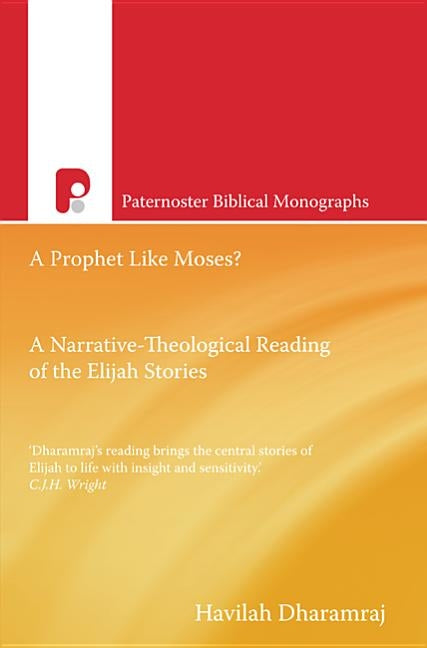

Description
In evaluating Elijah as a prophet after the Mosaic paradigm, Dr Havilah Dharamraj proposes a radically different schema for interpreting what is one of the most dramatic and difficult texts in the Old Testament, namely, the earthquake-wind-and-fire theophany at Horeb (1 Kings 19).
Since rabbinic times, the resonance between the Moses stories and the Elijah stories has been regularly noted. Taking into account that Deut. 18:18 promises Israel a 'prophet like Moses', this resonance compels an evaluation of Elijah, holding Moses as the benchmark. Here, scholarship struggles with a paradox. At Horeb Elijah fails in the critical prophetic task of intercession. Yet, his service as prophet is affirmed beyond doubt in his iconic whirlwind-and-chariots-of-fire exit. How are these to be reconciled? Is Elijah a prophet of Mosaic fibre or not? This work offers a strikingly different approach to the Elijah stories. Dharamraj employs the narrative critical method to offer a close reading of the text. Such an approach opens up intriguing possibilities in interpretation. Here, her analysis of the dramatic and difficult discourse of the earthquake-wind-fire- 'still, small voice' theophany at Horeb is notable. So also, is the case she carefully builds for whether Elijah emerges as the hoped-for 'prophet like Moses'.
Author: Havilah Dharamraj
Publisher: Paternoster Publishing
Published: 04/01/2011
Pages: 304
Binding Type: Paperback
Weight: 0.90lbs
Size: 9.00h x 6.00w x 0.64d
ISBN13: 9781842275337
ISBN10: 184227533X
BISAC Categories:
- Religion | Biblical Studies | Old Testament | General
This title is not returnable