Breathing, you invisible poem
World-space in pure continuous interchange
with my own being. Equipose
in which I rhythmically transpire.
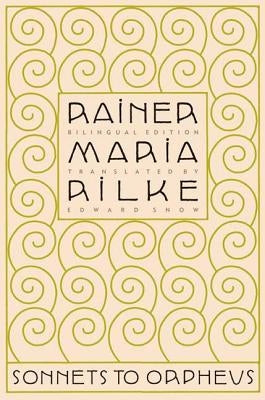
Written only four years before Rilke's death, this sequence of sonnets, varied in form yet consistently structured, stands as the poet's final masterwork. In these meditations on the constant flux of our world and the ephemerality of experience, Rilke envisions death not only as one among many of life's transformations but also as an ideally receptive state of being. Because Orpheus has visited the realm of death and returned to the living, his lyre, a unifying presence in these poems, is an emblem of fluidity and musical transcendence. And Eurydice, condemned to Hades as a result of Orpheus's backward glance, becomes in Rilke's universe a mythical figure of consolation and hope.
Edward Snow, in his translations of
New Poems,
The Book of Images,
Uncollected Poems, and
Duino Elegies, has emerged as Rilke's most able English-language interpreter. Adhering faithfully to the intent of Rilke's German while constructing nuanced, colloquial poems in English, Snow's
Sonnets to Orpheus should serve as the authoritative translation for years to come.
Author: Rainer Maria RilkePublisher: Farrar, Strauss & Giroux-3pl
Published: 05/18/2005
Pages: 144
Binding Type: Paperback
Weight: 0.40lbs
Size: 8.40h x 5.40w x 0.50d
ISBN13: 9780865477216
ISBN10: 0865477213
BISAC Categories:-
Poetry |
European | GeneralAbout the Author
Edward Snow is a professor of English at Rice University. He is the recipient of an Academy of Arts and Letters Award for his Rilke translations and has twice received the Academy of American Poets' Harold Morton Landon Translation Award.