
Facility Verification
Please verify the inmate's facility before purchasing.
OR
This Publication is Restricted at this Facility.

Description
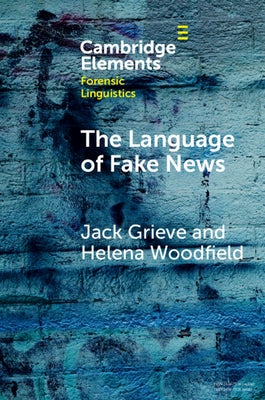
In this Element, the authors introduce and apply a framework for the linguistic analysis of fake news. They define fake news as news that is meant to deceive as opposed to inform and argue that there should be systematic differences between real and fake news that reflect this basic difference in communicative purpose. The authors consider one famous case of fake news involving Jayson Blair of The New York Times, which provides them with the opportunity to conduct a controlled study of the effect of deception on the language of a single reporter following this framework. Through a detailed grammatical analysis of a corpus of Blair's real and fake articles, this Element demonstrates that there are clear differences in his writing style, with his real news exhibiting greater information density and conviction than his fake news. This title is also available as Open Access on Cambridge Core.
Author: Jack Grieve, Helena Woodfield
Publisher: Cambridge University Press
Published: 04/27/2023
Pages: 75
Binding Type: Paperback
Weight: 0.28lbs
Size: 9.00h x 6.00w x 0.18d
ISBN13: 9781009349130
ISBN10: 1009349139
BISAC Categories:
- Language Arts & Disciplines | Linguistics | General
- Language Arts & Disciplines | Journalism
Author: Jack Grieve, Helena Woodfield
Publisher: Cambridge University Press
Published: 04/27/2023
Pages: 75
Binding Type: Paperback
Weight: 0.28lbs
Size: 9.00h x 6.00w x 0.18d
ISBN13: 9781009349130
ISBN10: 1009349139
BISAC Categories:
- Language Arts & Disciplines | Linguistics | General
- Language Arts & Disciplines | Journalism