
Facility Verification
Please verify the inmate's facility before purchasing.
OR
This Publication is Restricted at this Facility.

Description
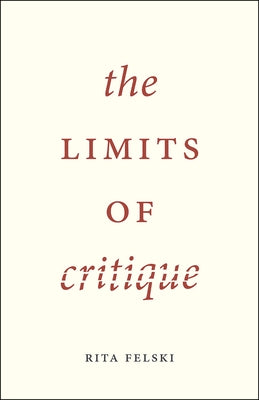
Why must critics unmask and demystify literary works? Why do they believe that language is always withholding some truth, that the critic's task is to reveal the unsaid or repressed? In this book, Rita Felski examines critique, the dominant form of interpretation in literary studies, and situates it as but one method among many, a method with strong allure--but also definite limits. Felski argues that critique is a sensibility best captured by Paul Ricoeur's phrase "the hermeneutics of suspicion." She shows how this suspicion toward texts forecloses many potential readings while providing no guarantee of rigorous or radical thought. Instead, she suggests, literary scholars should try what she calls "postcritical reading" rather than looking behind a text for hidden causes and motives, literary scholars should place themselves in front of it and reflect on what it suggests and makes possible. By bringing critique down to earth and exploring new modes of interpretation, The Limits of Critique offers a fresh approach to the relationship between artistic works and the social world.
Author: Rita Felski
Publisher: University of Chicago Press
Published: 10/20/2015
Pages: 240
Binding Type: Paperback
Weight: 0.60lbs
Size: 8.50h x 5.50w x 0.50d
ISBN13: 9780226294032
ISBN10: 022629403X
BISAC Categories:
- Literary Criticism | Semiotics & Theory
Author: Rita Felski
Publisher: University of Chicago Press
Published: 10/20/2015
Pages: 240
Binding Type: Paperback
Weight: 0.60lbs
Size: 8.50h x 5.50w x 0.50d
ISBN13: 9780226294032
ISBN10: 022629403X
BISAC Categories:
- Literary Criticism | Semiotics & Theory
About the Author
Rita Felski is the William R. Kenan Jr. Professor of English at the University of Virginia and the editor of New Literary History. She is the author of several books, including, most recently, Uses of Literature and Literature after Feminism, the latter also published by the University of Chicago Press.