

Description
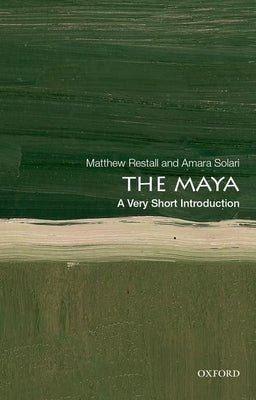
The Maya forged one of the greatest societies in the history of the ancient Americas -- and in all of human history. Long before contact with Europeans, Maya communities built spectacular cities with large, well-fed large populations. They mastered the visual arts, and developed a sophisticated
writing system that recorded extraordinary knowledge in calendrics, mathematics, and astronomy. The Maya achieved all this without area-wide centralized control. There was never a single, unified Maya state or empire, but always numerous, evolving ethnic groups speaking dozens of distinct Mayan
languages. The people we call Maya never thought of themselves as such; yet something definable, unique, and endlessly fascinating - what we call Maya culture - has clearly existed for millennia. So what was their self-identity and how did Maya civilization come to be invented? With the Maya historically subdivided and misunderstood in so many ways, the pursuit of what made them the Maya is all the more important. In this Very Short Introduction, Restall and Solari explore the themes of Maya identity, city-state political culture, art and architecture, the Maya concept
of the cosmos, and the Maya experience of contact with -- including invasion by -- outsiders. Despite its brevity, this book is unique for its treatment of all periods of Maya civilization, from its origins to the present.
Author: Matthew Restall, Amara Solari
Publisher: Oxford University Press, USA
Published: 10/21/2020
Pages: 152
Binding Type: Paperback
Weight: 0.25lbs
Size: 6.80h x 4.30w x 0.40d
ISBN13: 9780190645021
ISBN10: 0190645024
BISAC Categories:
- History | Latin America | Central America
- History | Americas (North Central South West Indies)
Very Short Introduction, and When Montezuma Met Cortés: The True Story of the Meeting Than Changed History. Amara Solari is Professor of Art History and Anthropology at Penn State University. She is the co-author of 2012 and the End of the World: The Western Roots of the Maya Apocalypse, and author of Maya Ideologies of the Sacred: The Transfiguration of Space in Colonial Yucatan, and Idolizing Mary:
Maya-Christian Icons in Early Modern Yucatán.
writing system that recorded extraordinary knowledge in calendrics, mathematics, and astronomy. The Maya achieved all this without area-wide centralized control. There was never a single, unified Maya state or empire, but always numerous, evolving ethnic groups speaking dozens of distinct Mayan
languages. The people we call Maya never thought of themselves as such; yet something definable, unique, and endlessly fascinating - what we call Maya culture - has clearly existed for millennia. So what was their self-identity and how did Maya civilization come to be invented? With the Maya historically subdivided and misunderstood in so many ways, the pursuit of what made them the Maya is all the more important. In this Very Short Introduction, Restall and Solari explore the themes of Maya identity, city-state political culture, art and architecture, the Maya concept
of the cosmos, and the Maya experience of contact with -- including invasion by -- outsiders. Despite its brevity, this book is unique for its treatment of all periods of Maya civilization, from its origins to the present.
Author: Matthew Restall, Amara Solari
Publisher: Oxford University Press, USA
Published: 10/21/2020
Pages: 152
Binding Type: Paperback
Weight: 0.25lbs
Size: 6.80h x 4.30w x 0.40d
ISBN13: 9780190645021
ISBN10: 0190645024
BISAC Categories:
- History | Latin America | Central America
- History | Americas (North Central South West Indies)
About the Author
Matthew Restall, Edwin Erle Sparks Professor of History and Anthropology and Director of Latin American Studies, Penn State University; Amara Solari, Professor of Art History and Anthropology, Penn State University.
Very Short Introduction, and When Montezuma Met Cortés: The True Story of the Meeting Than Changed History. Amara Solari is Professor of Art History and Anthropology at Penn State University. She is the co-author of 2012 and the End of the World: The Western Roots of the Maya Apocalypse, and author of Maya Ideologies of the Sacred: The Transfiguration of Space in Colonial Yucatan, and Idolizing Mary:
Maya-Christian Icons in Early Modern Yucatán.
CUSTOMER REVIEWS
Write A Review