
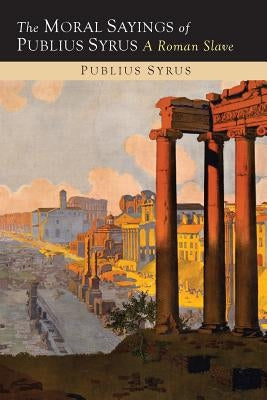

Description
2014 Reprint of 1856 Edition. Full facsimile of the original edition, not reproduced with Optical Recognition Software. Publius Syrus, a Latin writer of maxims, flourished in the 1st century BC. He was a Syrian who was brought as a slave to Italy, but by his wit and talent he won the favor of his master, who freed and educated him. All that remains of his corpus is a collection of moral maxims in iambic and trochaic verse. This collection must have been made at a very early date, since it was known to Aulus Gellius in the 2nd century AD. Each maxim consists of a single verse, and the verses are arranged in alphabetical order according to their initial letters. In the course of time the collection was interpolated with sentences drawn from other writers, especially from apocryphal writings of Seneca the Younger; the number of genuine verses is about 700. They include many pithy sayings, such as the famous "iudex damnatur ubi nocens absolvitur" ("The judge is condemned when the guilty is acquitted") adopted as its motto by the "Edinburgh Review."
Author: Publilius Syrus
Publisher: Martino Fine Books
Published: 07/10/2014
Pages: 92
Binding Type: Paperback
Weight: 0.32lbs
Size: 9.00h x 6.00w x 0.22d
ISBN13: 9781614276661
ISBN10: 1614276668
BISAC Categories:
- Philosophy | Ethics & Moral Philosophy
- Philosophy | History & Surveys | Ancient & Classical
- Literary Collections | Ancient, Classical & Medieval
Author: Publilius Syrus
Publisher: Martino Fine Books
Published: 07/10/2014
Pages: 92
Binding Type: Paperback
Weight: 0.32lbs
Size: 9.00h x 6.00w x 0.22d
ISBN13: 9781614276661
ISBN10: 1614276668
BISAC Categories:
- Philosophy | Ethics & Moral Philosophy
- Philosophy | History & Surveys | Ancient & Classical
- Literary Collections | Ancient, Classical & Medieval
This title is not returnable