
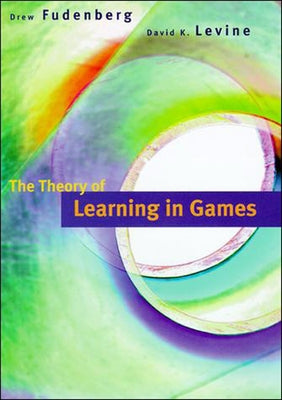

Description
In economics, most noncooperative game theory has focused on equilibrium in games, especially Nash equilibrium and its refinements. The traditional explanation for when and why equilibrium arises is that it results from analysis and introspection by the players in a situation where the rules of the game, the rationality of the players, and the players' payoff functions are all common knowledge. Both conceptually and empirically, this theory has many problems.
Author: Drew Fudenberg, David K. Levine
Publisher: MIT Press
Published: 06/03/1998
Pages: 294
Binding Type: Paperback
Weight: 0.96lbs
Size: 9.00h x 6.00w x 0.66d
ISBN13: 9780262529242
ISBN10: 0262529246
BISAC Categories:
- Business & Economics | Economics | Theory
- Mathematics | Game Theory
- Political Science | Political Economy
In The Theory of Learning in Games Drew Fudenberg and David Levine develop an alternative explanation that equilibrium arises as the long-run outcome of a process in which less than fully rational players grope for optimality over time. The models they explore provide a foundation for equilibrium theory and suggest useful ways for economists to evaluate and modify traditional equilibrium concepts.
Author: Drew Fudenberg, David K. Levine
Publisher: MIT Press
Published: 06/03/1998
Pages: 294
Binding Type: Paperback
Weight: 0.96lbs
Size: 9.00h x 6.00w x 0.66d
ISBN13: 9780262529242
ISBN10: 0262529246
BISAC Categories:
- Business & Economics | Economics | Theory
- Mathematics | Game Theory
- Political Science | Political Economy
About the Author
Drew Fudenberg is Professor of Economics at MIT.
CUSTOMER REVIEWS
Write A Review