
Facility Verification
Please verify the inmate's facility before purchasing.
This Publication is Restricted at this Facility.

Description
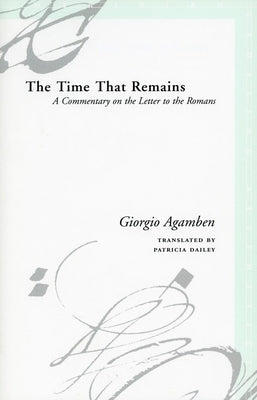
In The Time That Remains, Agamben seeks to separate the Pauline texts from the history of the Church that canonized them, thus revealing them to be the fundamental messianic texts of the West. He argues that Paul's letters are concerned not with the foundation of a new religion but rather with the messianic abolition of Jewish law. Situating Paul's texts in the context of early Jewish messianism, this book is part of a growing set of recent critiques devoted to the period when Judaism and Christianity were not yet fully distinct, placing Paul in the context of what has been called Judaeo-Christianity.
Agamben's philosophical exploration of the problem of messianism leads to the other major figure discussed in this book, Walter Benjamin. Advancing a claim without precedent in the vast literature on Benjamin, Agamben argues that Benjamin's philosophy of history constitutes a repetition and appropriation of Paul's concept of remaining time. Through a close reading and comparison of Benjamin's Theses on the Philosophy of History and the Pauline Epistles, Agamben discerns a number of striking and unrecognized parallels between the two works.
Author: Giorgio Agamben
Publisher: Stanford University Press
Published: 11/07/2005
Pages: 216
Binding Type: Paperback
Weight: 0.60lbs
Size: 8.50h x 5.50w x 0.70d
ISBN13: 9780804743839
ISBN10: 0804743835
BISAC Categories:
- Religion | Biblical Commentary | New Testament | General
- Religion | Philosophy
- Religion | Biblical Criticism & Interpretation | New Testament
About the Author
Giorgio Agamben is Professor of Philosophy at the University of Venice. Stanford University Press has published five of his previous books: Homo Sacer (1998), Potentialities: Collected Essays in Philosophy (1999), The Man Without Content (1999), The End of the Poem (1999), and The Open (2004).