
Facility Verification
Please verify the inmate's facility before purchasing.
This Publication is Restricted at this Facility.

Description
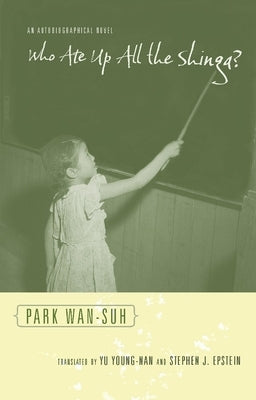
Park Wan-suh is a best-selling and award-winning writer whose work has been widely translated and published throughout the world. Who Ate Up All the Shinga? is an extraordinary account of her experiences growing up during the Japanese occupation of Korea and the Korean War, a time of great oppression, deprivation, and social and political instability.
Park Wan-suh was born in 1931 in a small village near Kaesong, a protected hamlet of no more than twenty families. Park was raised believing that "no matter how many hills and brooks you crossed, the whole world was Korea and everyone in it was Korean." But then the tendrils of the Japanese occupation, which had already worked their way through much of Korean society before her birth, began to encroach on Park's idyll, complicating her day-to-day life. With acerbic wit and brilliant insight, Park describes the characters and events that came to shape her young life, portraying the pervasive ways in which collaboration, assimilation, and resistance intertwined within the Korean social fabric before the outbreak of war. Most absorbing is Park's portrait of her mother, a sharp and resourceful widow who both resisted and conformed to stricture, becoming an enigmatic role model for her struggling daughter. Balancing period detail with universal themes, Park weaves a captivating tale that charms, moves, and wholly engrosses.Author: Wan-Suh Park
Publisher: Columbia University Press
Published: 05/31/2022
Pages: 264
Binding Type: Paperback
Weight: 0.67lbs
Size: 8.00h x 5.25w x 0.60d
ISBN13: 9780231148993
ISBN10: 0231148992
BISAC Categories:
- Fiction | Literary
- Fiction | War & Military
About the Author
Park Wan-suh broke into Korea's literary scene in the 1970s and in 1981 received the prestigious Yi Sang award for her novel Mother's Stake. Her prolific career includes more than 150 short stories and novellas and close to twenty novels, many of which have topped best-seller lists and have been adapted for the screen. Her works in translation include My Very Last Possession and The Naked Tree.